
How Industrial Barometric Condensers Support Steam Jet Ejector System Efficiency
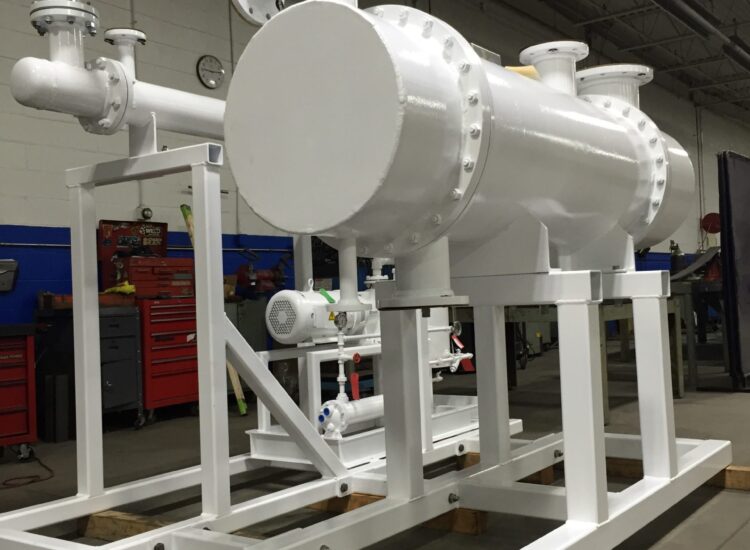
When engineers design or evaluate steam jet ejector systems, much of the attention naturally falls on the ejectors themselves. But one of the most impactful components in a multi-stage vacuum system is often the condenser positioned between ejector stages. Industrial barometric condensers play a critical role in reducing steam consumption, managing vapor loads, and sustaining stable vacuum performance across a wide range of industrial processes. Understanding how they function and why proper selection matters can make a measurable difference in both operating costs and system reliability.
What Is a Barometric Condenser?
A barometric condenser is a direct-contact condenser used in steam jet ejector systems to condense steam and condensable vapors between ejector stages. Cold water is introduced into the condenser shell and comes into direct contact with the incoming steam-gas mixture. The steam and condensable vapors are condensed, and the remaining non-condensable gases, primarily air or process gases, pass on to the next ejector stage at a significantly reduced load.
The term “barometric” refers to the installation height of the unit. When mounted at a sufficient elevation, typically around 34 feet above the condensate collection point, gravity drainage through a sealed tail leg, or barometric leg, allows condensate and condensing water to drain continuously without the need for pumps. This design is one of the simplest and most reliable approaches to condensate removal in vacuum systems.
The Role of Intercondensers in Multi-Stage Ejector Systems
In a multi-stage steam jet ejector system, achieving deep vacuum levels efficiently requires more than simply adding ejector stages in series. Without intercondensers, each successive ejector stage must handle the full load of the previous stage’s operating steam in addition to the original process gas load. This results in significantly larger ejector sizes, higher steam consumption, and increased operating costs.
When a barometric condenser is placed between ejector stages, it performs two important functions:
- Condensing operating steam from the preceding ejector stage, removing it from the gas stream before it reaches the next stage
- Cooling non-condensable gases, which reduces their volume and lowers the load on the downstream ejector
In a two-stage condensing ejector system, for example, the high-vacuum ejector discharges into an intercondenser where operating steam is condensed. The low-vacuum ejector then only needs to handle the remaining non-condensables and a much smaller vapor load. This reduction in load directly translates to smaller subsequent ejector stages and lower overall steam consumption compared to a non-condensing system of equivalent capacity.
The difference in operating efficiency between condensing and non-condensing configurations is significant. For systems that run continuously or handle high vapor loads, the condensing type arrangement with properly designed barometric condensers is generally the more economical choice over the long-term life of the system.
Three-Stage and Higher Systems
As process requirements push into lower absolute pressure ranges, three-stage, four-stage, and higher multi-stage ejector systems come into play. In three-stage condensing systems, the configuration typically includes a booster ejector, a booster condenser, and then a two-stage condensing arrangement with a high-vacuum ejector, an intercondenser, and a low-vacuum ejector.
Each condenser in this configuration reduces the load passed downstream, and the cumulative effect of multiple intercondensers in a well-designed system is a substantial reduction in total steam consumption compared to an equivalent non-condensing arrangement.
For four, five, and six-stage systems used to achieve very low suction pressures, barometric condensers are even more critical. In a four-stage system, a condenser positioned after the secondary booster ejector condenses operating steam and condensable gases before the load reaches the high-vacuum and low-vacuum ejector stages. Without this vapor removal step, the downstream stages would require disproportionately large sizes to handle the cumulative steam load.
Gravity Drainage and the Barometric Leg
One of the practical advantages of a barometric installation is the elimination of condensate removal pumps. When the condenser is mounted at barometric height, typically around 34 feet of elevation above the condensate pit or seal pot, the pressure differential between the condenser and atmosphere is sufficient to drive drainage by gravity through the tail leg.
The tail leg is sealed at the bottom in a collection vessel filled with water. This seal prevents air from being drawn back into the system, which would destroy the vacuum. As long as the barometric leg is properly sized and maintained, the system drains passively and continuously without mechanical intervention.
This arrangement simplifies system operation and eliminates a potential failure point. In contrast, pump-based condensate removal systems introduce a dependency on pump reliability and add maintenance requirements over time.
Direct-Contact vs. Surface Condensers: When Barometric Makes Sense
Industrial condensers used in ejector systems fall into two broad categories: direct-contact condensers, which include the barometric type, and surface condensers, which keep the process fluid and condensing water physically separated.
Direct-contact barometric condensers are generally the lower-cost option and require less motive steam to achieve comparable vacuum performance. For applications where the condensing water can be combined with the process condensate and discharged to drain without concern, barometric condensers are often the preferred choice. They are widely used in chemical processing, petroleum refining, power generation, food processing, pulp and paper, and water treatment applications.
Surface condensers, by contrast, are required when the process stream contains contaminants that cannot be discharged directly to a drain, or when the condensate must be recovered or treated separately. Surface condensers are more expensive to procure and operate but are essential in applications where direct contact between the cooling water and the process condensate is not acceptable.
Understanding which condenser type fits the application is a critical part of overall vacuum system design, and the choice between barometric direct-contact and surface condensers will influence ejector sizing, steam consumption, water consumption, and overall lifecycle cost.
Cooling Water Temperature: A Critical Variable
The vacuum achievable in a direct-contact condenser is limited by the vapor pressure of the cooling water at the temperature it enters the condenser. This is a physical constraint that every process engineer should account for during system design and when evaluating field performance.
As cooling water temperature increases, the vapor pressure of the water rises, and the minimum achievable vacuum in the condenser becomes less deep. If cooling water temperature increases unexpectedly due to seasonal changes or process upsets, the intercondenser may no longer condense steam to the design level, increasing the load on downstream ejector stages and potentially degrading overall vacuum system performance.
For applications where a deeper vacuum is required than the cooling water temperature can support at the condenser level, a steam jet booster can be added upstream of the condenser to compress vapor to a higher intermediate pressure before condensing. This allows the condensing step to occur at a pressure level compatible with the available cooling water temperature.
Low-Level Arrangements for Height-Constrained Installations
Not every industrial facility can accommodate the 34-foot elevation required for a gravity-drain barometric installation. In these cases, low-level condenser arrangements are used to achieve direct-contact condensing without the barometric leg.
Low-level systems typically incorporate either a direct-contact condenser with an integral reservoir and a float-operated water control valve, or a shell-and-tube heat exchanger with a pump-operated water jet ejector to remove condensate. Both approaches allow the ejector system to benefit from intercondensing even when building height or structural constraints rule out a conventional barometric installation.
The ejectors used in low-level systems are identical to those used in barometric installations. The difference lies entirely in the condensate removal method, which allows design engineers to apply the same core ejector technology across different plant configurations.
Matching Condenser Design to Process Requirements
Selecting the right barometric condenser for a steam jet ejector application requires accurate knowledge of several process variables, including the suction load in pounds per hour, the molecular weight and specific heat of the gas being handled, the available cooling water temperature and flow rate, the required suction pressure, and whether direct-contact condensing of the process stream is permissible.
Providing complete and accurate data at the specification stage allows the system designer to properly size each condenser and ejector stage, optimize inter-stage pressures, and confirm that the overall system will achieve the required vacuum at the anticipated steam and cooling water conditions.
An undersized intercondenser can reduce system efficiency, increase steam consumption, and place excessive load on downstream ejectors. An oversized condenser wastes capital without delivering proportional benefit. Proper sizing is an engineering exercise that requires experience with real-world ejector system performance across a range of industrial applications.
Conclusion
In any multi-stage steam jet vacuum system where efficiency and reliability matter, the design and selection of intercondensers deserves as much attention as the ejectors themselves. Industrial barometric condensers reduce vapor loads between stages, lower total steam consumption, simplify condensate drainage, and support more stable vacuum system operation over time. Whether the application is vacuum distillation in a petroleum refinery, solvent recovery in a chemical plant, or evaporation in a food processing facility, the condenser system is a core part of the overall vacuum solution, not an afterthought.
For process engineers evaluating new installations or troubleshooting underperforming vacuum systems, reviewing condenser sizing, cooling water temperature, and condensate drainage integrity is often a productive first step toward improving overall system performance.


